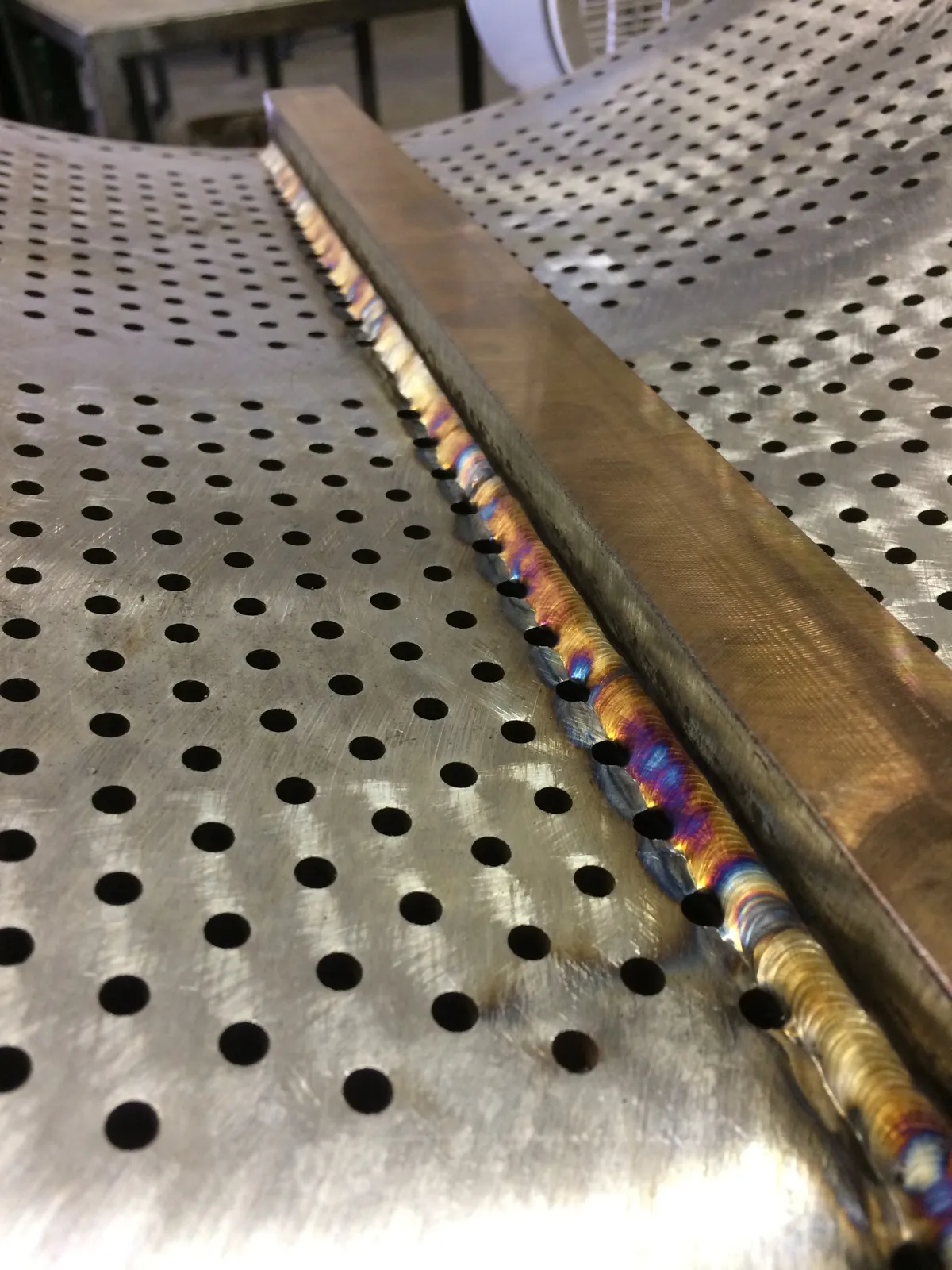
Sheet metal welding is a different discipline from welding plate. The material is thin enough to burn through, it moves as it cools, and the weld is often the surface the customer sees. Weld Creations TIG welds formed, stamped and laser-cut sheet metal in stainless steel, aluminum and steel at our Glendora, California shop, on parts we fabricate and on parts our customers send in.
Have sheet metal parts that need welding? Send the flat pattern or the formed part drawing. Request a quote.
Why thin gauge is harder, not easier
Everything that makes welding difficult gets worse as the material gets thinner:
- Burn-through. A fraction of a second too long in one place and there’s a hole in the part.
- Distortion. The weld shrinks as it cools and drags the panel with it. On a flat cover or an enclosure face, that shows.
- Fit-up intolerance. A gap that’s irrelevant on quarter-inch plate is unbridgeable on 22 gauge.
- No room to grind it out. On thick material you can dress a weld back. On sheet, there isn’t enough metal to remove.
- Cosmetics. Thin parts are usually the visible ones: covers, housings, guards, trim and enclosures.
The work is therefore mostly about preparation and control, and very little about depositing metal.
How we keep sheet metal flat
Fixturing. Parts are held in position through welding and through cooling, which is when most distortion happens. For repeat parts the fixture becomes part of the process, so every unit comes out the same.
Weld sequencing. Welds are placed and ordered to balance heat around the part rather than pulling it one direction. On a long seam that usually means a sequence of short welds worked outward from the centre, not a single pass end to end.
Low heat input. TIG welding gives the operator independent control of current and filler, and puts in a fraction of the heat of other processes. Pulsed current reduces it further on the thinnest material.
Stitch welding where the design allows. A stitched seam that meets the load requirement puts a fraction of the heat into the panel that a continuous bead does. We’ll tell you when a drawing calls for more weld than the part needs.
Chills and heat sinks. Copper backing bars draw heat out of the joint, support the root and prevent blow-through on butt welds.
Good fit-up before the arc is struck. Most burn-through is a fit-up problem wearing a welding costume. We check parts in, and we tell you if a formed part isn’t going to close up.
What we weld
- Enclosures, housings and covers in stainless and aluminum, including sealed and watertight assemblies
- Guards, panels, trays and chutes
- Stampings and drawn parts welded into assemblies, for metal stamping companies
- Laser-cut and press-brake parts sent in by fabricators and machine shops
- Perforated screens, stiffeners and framed panels
- Sanitary sheet metal for food and pharmaceutical equipment, welded crevice-free and ground smooth. See sanitary welding.
- Spot welded lap joints where a continuous fusion weld would distort the panel for no structural gain
- Repairs and modifications to existing sheet metal equipment
Welds that get polished, plated or painted
If the part is going to a finisher, the weld has to be built for it from the start. Polishing magnifies undercut and uneven bead profile rather than removing them, plating highlights porosity, and powder coating telegraphs a lumpy seam. We weld cosmetic work with consistent bead placement, clean starts and stops, and the minimum material needed, then dress and blend it so the finisher gets a surface that takes the process evenly. Tell us the finish at quote time, because it changes how the joint is designed and welded.
Thin stainless and the back side
Stainless oxidizes fast at welding temperature, and on thin material the root side goes first. That oxide layer is chromium-depleted, which means the metal under it resists corrosion less well than the rest of the part, and on product-contact surfaces it’s a real failure risk rather than a cosmetic one. We back purge full-penetration joints with argon as standard and control heat input to limit discoloration in the first place. The detail is in weld heat tint and back purging.
Materials and thickness
Stainless steel in 304, 316 and the L grades, aluminum in 5052, 5083, 6061 and similar, carbon and galvanized-substrate steel, and titanium where the application calls for it. We weld routinely from about 22 gauge up through light plate, and across that range into heavier machined or tubular parts where an assembly mixes thicknesses.
Fabrication, or welding only
Some customers send a drawing and we handle the whole part, with cutting and forming through our partner network and the welding and finishing here. See custom metal fabrication. Others cut and form in house and send us only the welding, which is the arrangement most fabricators and machine shops prefer. Both work, and the second is often faster.
What to send for a quote
The drawing or STEP file, the material and gauge, the quantity, the weld requirements, the finish the part is going to, and anything that has to stay flat or in position. We reply within one business day. For a summary of what we run, see our capabilities.