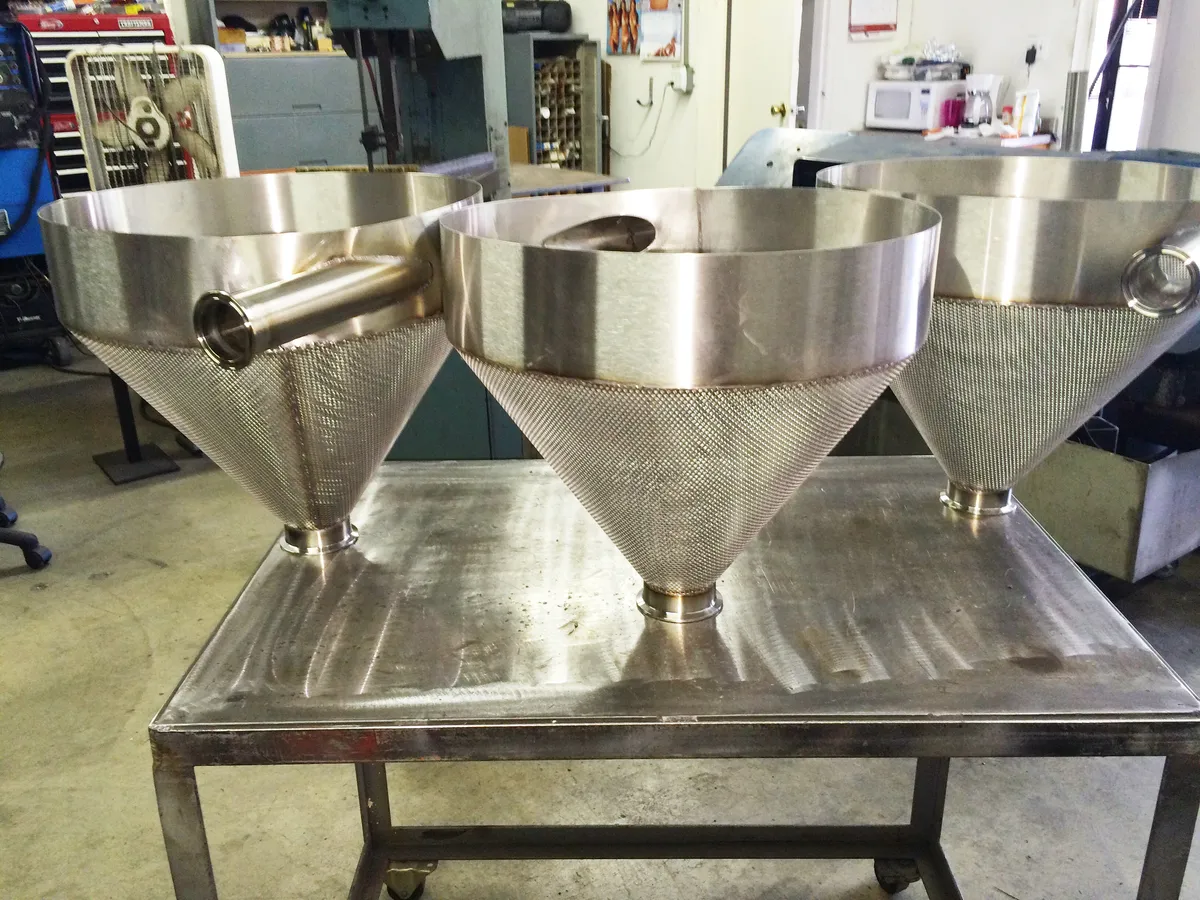
Weld Creations is a sanitary welding and fabrication shop in Glendora, serving manufacturers across Los Angeles and Southern California. We TIG weld stainless steel equipment that has to stay clean: hoppers, chutes, frames, enclosures, tube assemblies and machine components for pharmaceutical, nutraceutical and food production. Every product-contact weld is full penetration, back purged and finished so there’s nowhere for product or bacteria to hide.
If you’re sourcing a sanitary welding company, the questions that matter are simple. Will the welds pass your inspection, will the finish meet your spec, and will the documentation satisfy your quality team? That’s what this page covers.
What makes a weld sanitary
A structural weld only has to be strong. A sanitary weld also has to be cleanable, which changes how the joint is designed, welded and finished.
- Full penetration with a smooth, flush root. On tube and pipe, the inside bead must be consistent, with no lack of fusion, excessive root protrusion or concavity that can trap product.
- No crevices. Lap joints, stitch welds and gaps are where residue and biofilm build up. Product-contact seams are continuous, and joints are designed to be welded completely.
- Controlled heat tint. Stainless steel that gets too hot without shielding forms an oxide layer (“sugaring” in severe cases) that reduces corrosion resistance. We back purge with argon and control heat input to keep discoloration within the limits your spec allows.
- Free-draining geometry. Sloped surfaces, radiused internal corners and no horizontal ledges in the product zone, so equipment drains and cleans properly.
- A surface finish that matches the spec. Welds are blended and polished to the roughness your drawing calls out.
Materials and finishes
Most sanitary work is 316L stainless steel for product-contact parts and 304 / 304L for frames, guards and structure. The low-carbon “L” grades resist sensitization, the loss of corrosion resistance next to a weld. For aggressive process chemistry we also weld nickel alloys such as Hastelloy.
Finish requirements vary by industry and by part. Food-contact surfaces are commonly specified around 32 µin Ra or smoother. Pharmaceutical product-contact surfaces are often specified smoother still. Put the Ra value and any electropolish requirement on the drawing, and we’ll quote the finishing along with the fabrication.
| Part zone | Typical material | What we control |
|---|---|---|
| Product contact (hoppers, chutes, tube) | 316L | Full-penetration welds, back purge, blend and polish to spec |
| Splash zone and enclosures | 316L or 304 | Continuous seams, cleanable geometry |
| Frames, stands, guards | 304 / 304L | Sealed tubing, no open ends, clean welds |
Tube, pipe and equipment fabrication
Sanitary work falls into two groups, and we handle both:
Equipment and components. This includes feed hoppers with perforated cones, product chutes, bins, enclosures, machine frames, guards and equipment stands, the kind of stainless work shown in our gallery from pharmaceutical and nutraceutical production rooms.
Tube assemblies. This means sanitary tube runs, spools and assemblies with ferrules and tri-clamp connections, made to your isometric or drawing. When a specification calls for automated orbital welding of process tubing, we deliver it through our partner network, with the fabrication, fit-up and project management kept in one place.
Our TIG welding is the foundation of all of it. Precise heat control is what makes a clean, consistent sanitary weld possible on thin-wall stainless.
Built to your specification
We don’t guess at requirements. Your drawing and specification define the job: the standard your equipment must meet (such as ASME BPE or 3-A), the surface finish, the weld acceptance criteria and the documentation package. We quote to it and fabricate to it.
Tell us what your quality team needs with the parts: material test reports and heat-number traceability, weld logs, inspection photos, or a finish verification. We’ll build the package alongside the order. Any finishing we don’t do in-house, such as passivation or electropolishing, is handled through specialist partners. You still get one supplier, one purchase order and one point of accountability.
From prototype to production
Many sanitary projects start as a one-off, such as a replacement hopper, a modified chute or a prototype enclosure, and then become a recurring part. We fixture repeat work so the tenth part matches the first. See production welding for how we run repeat orders, and our capabilities page for a printable summary to share with purchasing.
Industries we support
- Pharmaceutical and nutraceutical. Tablet press and capsule-line equipment, hoppers, frames and cleanroom stainless. See pharmaceutical equipment fabrication.
- Food and beverage. Hoppers, chutes, conveyor components and processing equipment where cleanability is non-negotiable.
- Supplements and vitamins. Powder handling equipment and machine components for high-changeover production.
Request a sanitary welding quote
Send a drawing (or a photo and dimensions for a replacement part), the material, the quantity, your finish and documentation requirements, and your timeline. We’ll reply within one business day.