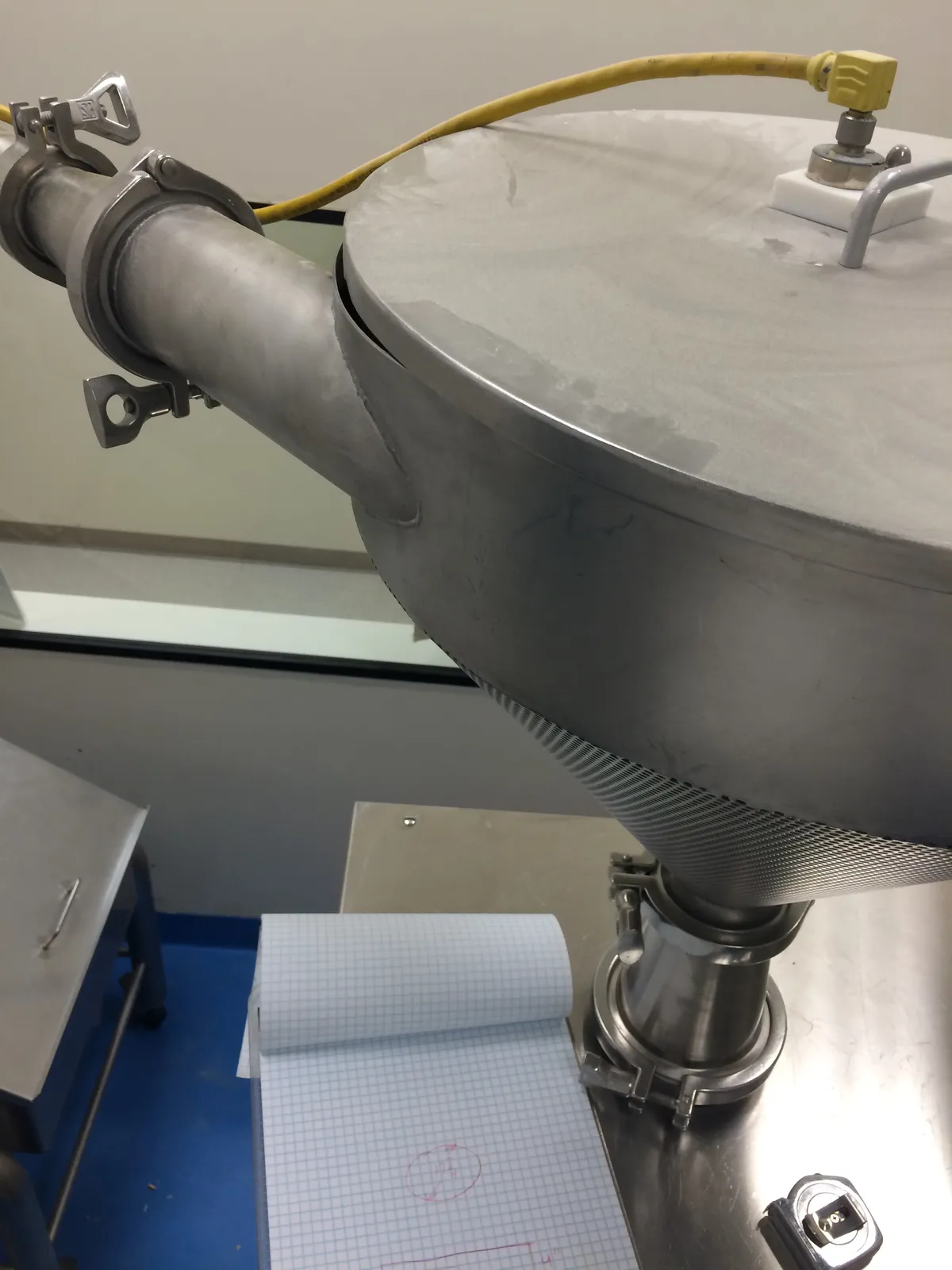
Weld Creations provides food grade stainless steel fabrication for food and beverage producers and equipment builders across Southern California. We build hoppers, chutes, frames, guards and equipment components in 304 and 316 stainless, TIG welded with continuous, crevice-free seams and finished to be cleaned and inspected every shift.
In a food plant, equipment gets judged twice: once on whether it does its job, and again at every sanitation cycle on whether it comes clean. We build for both.
Hygienic design, built in
Most sanitation problems start as fabrication decisions. We build food equipment around the principles your sanitation and food safety teams care about:
- Continuous welds on food-contact surfaces. No stitch welds, lap joints or gaps where product and bacteria collect. Seams are fully welded, then blended smooth.
- Sealed hollow sections. Tubing and frames are sealed so water and product can’t get inside and harbor bacteria. There are no open tube ends.
- Sloped and drainable surfaces. Tops, ledges and frames are designed so wash water runs off instead of pooling.
- Radiused internal corners. Easy to reach and clean, and no sharp crevices.
- Smooth finishes. Food-contact welds are ground and polished to the surface roughness your specification calls for.
- Clean-in-place compatibility. Joints are fully penetrated and smooth on the inside of tube and closed sections. See sanitary welding.
Material selection
| Environment | Typical grade | Why |
|---|---|---|
| General food contact, dry products | 304 / 304L | Proven, cost-effective and corrosion resistant |
| Salty, acidic or high-chloride products | 316 / 316L | Molybdenum resists pitting and crevice corrosion |
| Aggressive cleaning chemicals, wet wash-down | 316L | Better resistance to caustic and sanitizer exposure |
| Frames, guards and non-contact structure | 304 | Hygienic construction at lower cost |
For a deeper look at alloys, fillers, heat tint and passivation, see stainless steel welding.
Equipment we fabricate
Product handling
- Feed hoppers with perforated or solid cones, inlets and clamp outlets
- Chutes, transitions and discharge assemblies
- Bins, trays and product guards
Structure and access
- Conveyor frames, supports and stands built for wash-down
- Platforms, stairs and access frames
- Enclosures, panels and machine guards
Modification and repair
- Replacement hoppers and chutes built to fit existing equipment
- Added ports, brackets and mounts on existing stainless
- Frame rebuilds and weld repairs to hygienic standards
Built to your specification
Food safety programs, customer audits and industry standards all shape what your equipment needs. Your drawing and specification define the job: the standard (such as 3-A sanitary standards or your plant’s hygienic design standard), finish, acceptance criteria and documentation. We quote and fabricate to it.
Tell us what your quality or food safety team needs with delivery, such as material test reports, finish verification or photos of welds before assembly, and we’ll include it. Passivation and other finishing are available through our partner network.
From one-off to production
Food plants often need a single replacement part fast, then more of the same later. We build to your drawing, or from the old part and photos, and can fixture repeat items for consistent production runs. For larger builds, our metal fabrication service covers cutting, forming and assembly.
Built to survive wash-down
Food equipment lives through daily high-pressure washing, caustic cleaners and sanitizers. Construction details matter: fully sealed welds on frames, no exposed threads in wash-down zones, and stainless fasteners and hardware throughout. Equipment built this way stays hygienic and keeps passing inspection for years, not just at startup.
Why Weld Creations
Sanitary stainless is one of our specialties, and much of our gallery shows it: hoppers with perforated cones, clamp fittings and polished stainless in production environments. We’re AWS D17.1 certified, and we bring precision TIG welding to every food-contact seam. See our capabilities.
What to include in a food equipment RFQ
- Drawing, or the old part. A drawing is ideal. For replacements, photos with key dimensions, or the original part, work too.
- Grade and finish. 304 or 316, food-contact surface roughness, and whether passivation is required.
- Connections and interfaces. Clamp sizes, mounting points and the equipment the part attaches to.
- Wash-down conditions. Cleaning chemicals, temperature and pressure, which affect grade and construction.
- Standards and documentation. The hygienic standard your plant follows and what your food safety team needs with delivery.
- Timeline. Especially if the part is holding up a line.
Request a quote
Send the drawing (or photos and dimensions of the part being replaced), grade, finish requirements, quantity and timeline. We reply within one business day.